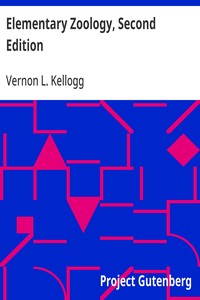
Elementary Zoology, Second Edition by Vernon L. Kellogg
Let's be clear: this is not a novel. Elementary Zoology is exactly what it says on the cover—a textbook from 1915 designed to introduce students to the animal world. But that's what makes it so interesting. Author Vernon L. Kellogg, a respected entomologist of his time, walks you through the entire animal kingdom, group by group. He starts with simple life forms and works his way up to mammals, explaining body structures, habits, and how different animals are related.
The Story
There's no plot, but there is a journey. The 'story' is the journey of scientific discovery as it stood over a century ago. Kellogg acts as your guide, pointing out the wonders of insect anatomy, the complexity of a bird's wing, and the simple life of a clam. He explains things with the certainty of his time, which means you'll find ideas about evolution and inheritance that we now know are incomplete or just plain wrong. Reading it, you feel like you're sitting in a classroom in the early 1900s, learning the cutting-edge science of the day.
Why You Should Read It
You should read this not for current facts, but for perspective. It’s a history book disguised as a science book. Kellogg's passion is genuine and contagious. His descriptions of how a spider builds its web or how bees communicate are filled with awe. It reminds you that the natural world is incredible, no matter the century. More importantly, it shows how science works—it builds on itself. Seeing the 'old' knowledge makes you appreciate the 'new' knowledge we have today. It’s humbling and fascinating to see what has stood the test of time and what has been revised.
Final Verdict
This book is not for everyone. It's definitely not for someone looking for a quick, easy read. But if you're a naturally curious person, a history of science buff, or a teacher who wants to show students how textbooks change, it's a gem. It’s perfect for readers who love nature, enjoy historical artifacts, and don't mind a slower, thoughtful pace. Think of it as a museum exhibit you can hold in your hands—a direct line to the mind of a scientist from a world before DNA, quantum theory, and the internet.
This masterpiece is free from copyright limitations. Use this text in your own projects freely.
Michael Martinez
10 months agoJust what I was looking for.
Aiden Martin
4 months agoHaving read this twice, the content flows smoothly from one chapter to the next. Highly recommended.