
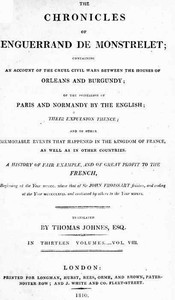
The chronicles of Enguerrand de Monstrelet, Vol. 08 [of 13] : containing an…
Let's be clear from the start: this is not a novel. If you're looking for a fast-paced plot with a clear beginning, middle, and end, you've grabbed the wrong book. This is a chronicle, a year-by-year record of events as witnessed or reported by Enguerrand de Monstrelet, a man who lived through one of Europe's longest and most complicated conflicts.
The Story
Volume 08 covers the early 1430s, a period in the Hundred Years' War where outright conquest gave way to a weary, brutal stalemate. The big picture is the struggle between the English, holding parts of France, and the French under King Charles VII. But Monstrelet doesn't give us the big picture first. He gives us the details: the siege of a specific castle that lasts for months, the failed peace talks at Auxerre, the movements of armies led by figures like the Duke of Bedford and Arthur de Richemont. You'll read about local skirmishes, the raising of taxes to pay for soldiers, and the constant, grinding impact of war on towns and the countryside. The 'plot' is the relentless, confusing reality of a conflict with no end in sight.
Why You Should Read It
I love this book for its sheer, unvarnished authenticity. Monstrelet isn't a poet or a philosopher; he's more like a meticulous, slightly grumpy town clerk reporting the news. There's no grand moralizing, just a record of events that often feel futile. This is its power. You get a profound sense of how exhausting and chaotic life was. One page details a solemn truce, and a few pages later, someone has broken it. It shows history not as a series of decisive battles, but as a daily struggle for survival and advantage. Reading Monstrelet is like listening to a very well-informed, slightly overwhelmed local explaining why the roads are unsafe and why prices are so high.
Final Verdict
This book is a specialized treat. It's perfect for history buffs and medievalists who have moved past the overviews and want to swim in the deep, murky waters of primary-source detail. It's also great for writers or world-builders looking to understand the gritty texture of medieval warfare and politics—the logistics, the betrayals, the sheer administrative headache of it all. A casual reader might find the endless names and places challenging, but for the right person, it's utterly absorbing. Think of it as the ultimate 'you are there' experience for a pivotal, messy moment in time.
This historical work is free of copyright protections. Feel free to use it for personal or commercial purposes.
William Garcia
5 months agoInitially, I was looking for a specific answer, but the author’s unique perspective adds a fresh layer to the discussion. I appreciate the effort that went into this curation.
Karen Lee
9 months agoIt effectively synthesizes complex ideas into a coherent whole.
Michael Jackson
1 year agoComprehensive and well-researched.
Betty Lopez
1 year agoSolid story.
Mary Anderson
3 months agoThe clarity of the introduction set high expectations, and the way the author breaks down the core concepts is remarkably clear. This has become my go-to guide for this specific topic.