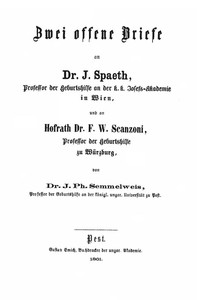
Zwei offene Briefe an Dr. J. Spaeth, Professor der Geburtshilfe an der k. k.…
Let's set the scene: Vienna, 1847. In the maternity wards, a nightmare called 'childbed fever' is killing up to one in three new mothers. Doctors move from dissecting corpses to delivering babies without a second thought. Enter a young Hungarian doctor, Ignác Semmelweis. He notices a pattern: the death rate is far lower in the ward run by midwives than the one run by doctors and medical students. His grim conclusion? Doctors are carrying 'cadaverous particles' on their hands from the autopsy room to the delivery room. His solution? A chlorine wash. It works. Deaths plummet. Case closed, right? Not even close.
The Story
This book is the explosive fallout. Years later, ignored and mocked by his peers, Semmelweis writes two public letters to his former professor, Dr. Spaeth. This isn't a calm, peer-reviewed paper. It's an accusation. He lays out his evidence with the clarity of someone who knows he's right. He names doctors and hospitals, pointing to their high death rates as proof of their negligence. He pleads, he argues, he shames. The 'plot' is his struggle to be heard, and the 'characters' are the faceless, powerful men who would rather see women die than admit a simple, humble Hungarian might be onto something they missed.
Why You Should Read It
You should read this because it's a masterclass in passionate argument. You feel Semmelweis's humanity—his desperation, his anger, his profound sadness. He isn't just defending a theory; he's defending the lives of mothers. The real theme here isn't germs; it's the danger of ego in institutions. It's about how hard it is to change minds, even with proof. Reading his words, you're not just learning medical history; you're witnessing a man's spirit breaking against a wall of tradition. It makes you think about the 'obvious' truths we ignore today.
Final Verdict
This is a must-read for anyone interested in the messy human side of scientific progress, for fans of stories about underdogs versus the system, or for those who enjoy short, powerful nonfiction that packs an emotional punch. It's not a long biography or a detailed medical textbook. It's a snapshot of a crisis point, a cry for help preserved on paper. Perfect for history buffs, science communicators, or anyone who needs a reminder that fighting for the truth, even when you're right, can be a lonely and heartbreaking battle.
This content is free to share and distribute. You can copy, modify, and distribute it freely.