
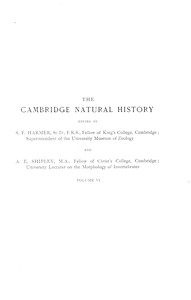
The Cambridge natural history, Vol. 06 (of 10) by David Sharp
Let's be clear from the start: this isn't a novel. The Cambridge Natural History, Volume 6 is a detailed scientific reference work focused entirely on insects. Published in the early 1900s, it represents the collective knowledge of its time, with David Sharp as the lead editor for this volume. Think of it as a massive field guide, but one written before modern genetics or even a complete understanding of insect behavior. It systematically covers different orders—like beetles, butterflies, and flies—describing their anatomy, life cycles, and classification.
The Story
There's no traditional plot. Instead, the 'story' is the unfolding of a scientific mission. The book documents a specific moment in history when naturalists were scrambling to name, categorize, and make sense of the overwhelming diversity of insect life. You follow Sharp as he lays out the known facts, debates different classification systems, and points out glaring gaps in knowledge. It's the narrative of discovery itself, written in real-time by someone in the thick of it. You see the foundations of entomology being laid, brick by meticulous brick.
Why You Should Read It
You read this for the perspective. It's humbling and fascinating to see what brilliant minds knew (and didn't know) over a century ago. Sharp's writing, while technical, is often filled with genuine awe for his subjects. You get a real sense of the patience and sheer physical effort required for this work—endless hours with a microscope, collecting specimens, and arguing over tiny details. It makes you appreciate how much we've learned, but also how much of this foundational work still holds up. It’s a direct connection to the roots of modern biology.
Final Verdict
This is a niche read, but a rewarding one. It's perfect for history of science enthusiasts, amateur naturalists, or anyone with a deep curiosity about how scientific knowledge is built. It's not a casual bedtime read. But if you've ever looked at a beetle and wondered how we even began to understand it, this volume offers a raw, unfiltered look at the process. Approach it not as a source of current facts, but as a primary document from the age of exploration—only the frontier was your own backyard.
This digital edition is based on a public domain text. Share knowledge freely with the world.
Charles Johnson
1 year agoIf you're tired of surface-level information, the transition between theoretical knowledge and practical application is seamless. This has become my go-to guide for this specific topic.
Joshua Scott
1 year agoTo be perfectly clear, it provides a comprehensive overview perfect for everyone. Definitely a 5-star read.
Christopher Taylor
1 year agoThis book was worth my time since the pacing is just right, keeping you engaged. Exactly what I needed.
Liam Rodriguez
7 months agoA must-have for anyone studying this subject.





David Anderson
7 months agoThe methodology used in this work is academically sound.