
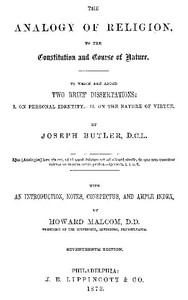
The Analogy of Religion to the Constitution and Course of Nature by Joseph Butler
Okay, let's break this down. This isn't a novel with a plot, so thinking of it as a 'story' is a bit different. The 'story' here is the argument itself.
The Story
Think of Butler as a lawyer building a case. His client is the reasonableness of the Christian faith, and the jury is made up of thoughtful but doubtful people of his time (and ours). He knows he can't 'prove' God in a lab, so he takes a different path. He points to the world around us. Nature is full of things we accept without full understanding: why we suffer, how consciousness arises, the seeming randomness of events. Butler's core move is to say, 'The structure of revealed religion has the same kind of challenges as the constitution of nature.' If we live comfortably with mystery and apparent injustice in the natural order, he argues, we shouldn't use those same qualities as a reason to dismiss religion. The book walks through big topics—life after death, morality, divine government—and constantly draws parallels back to our everyday experience of the natural world.
Why You Should Read It
I loved this book for its intellectual honesty. Butler isn't trying to shout down doubt; he's meeting it on its own ground. Reading it feels like watching a master craftsman at work. His tone is calm, patient, and deeply respectful of the reader's intelligence. Even if you don't agree with his conclusions, you have to admire the structure of his thought. It's a brilliant example of using analogy not as a cheap trick, but as a serious tool for understanding. For me, it was less about being convinced of a specific religious point and more about appreciating a powerful way of thinking. It teaches you to look for connections and patterns between seemingly separate parts of your life and your worldview.
Final Verdict
This book is perfect for anyone who enjoys a slow, thoughtful mental workout. It's great for readers interested in the history of ideas, philosophy, or theology. If you liked C.S. Lewis's Mere Christianity, you'll see where some of that logical, analogy-based style comes from (Butler was a big influence). It's also surprisingly good for skeptics who want to engage with a classic defense of faith that doesn't rely on dogma. Fair warning: it's an 18th-century text, so the language is formal and the pace is deliberate. It's not a beach read, but for a quiet afternoon with a cup of tea and an active mind, it's incredibly rewarding. You'll come away feeling like you've had a conversation with one of history's great, careful thinkers.
This text is dedicated to the public domain. You are welcome to share this with anyone.
Ashley Gonzalez
3 weeks agoI particularly value the technical accuracy maintained throughout.
George Davis
6 months agoI was skeptical about the depth of this book at first, but the way it handles controversial points with balance is quite professional. Definitely a five-star contribution to the field.
David Rodriguez
3 months agoThe methodology used in this work is academically sound.
David Martinez
1 month agoWhile browsing through various academic sources, the breakdown of complex theories into digestible segments is masterfully done. The price-to-value ratio here is simply unbeatable.


George Johnson
9 months agoI wanted to compare this perspective with traditional views, the author manages to bridge the gap between theory and practice effectively. A rare gem in a sea of mediocre content.